Small Crest Clamshell Presses
Informed buyers make better decisions. Trained operators make better production. DCA exists for both.

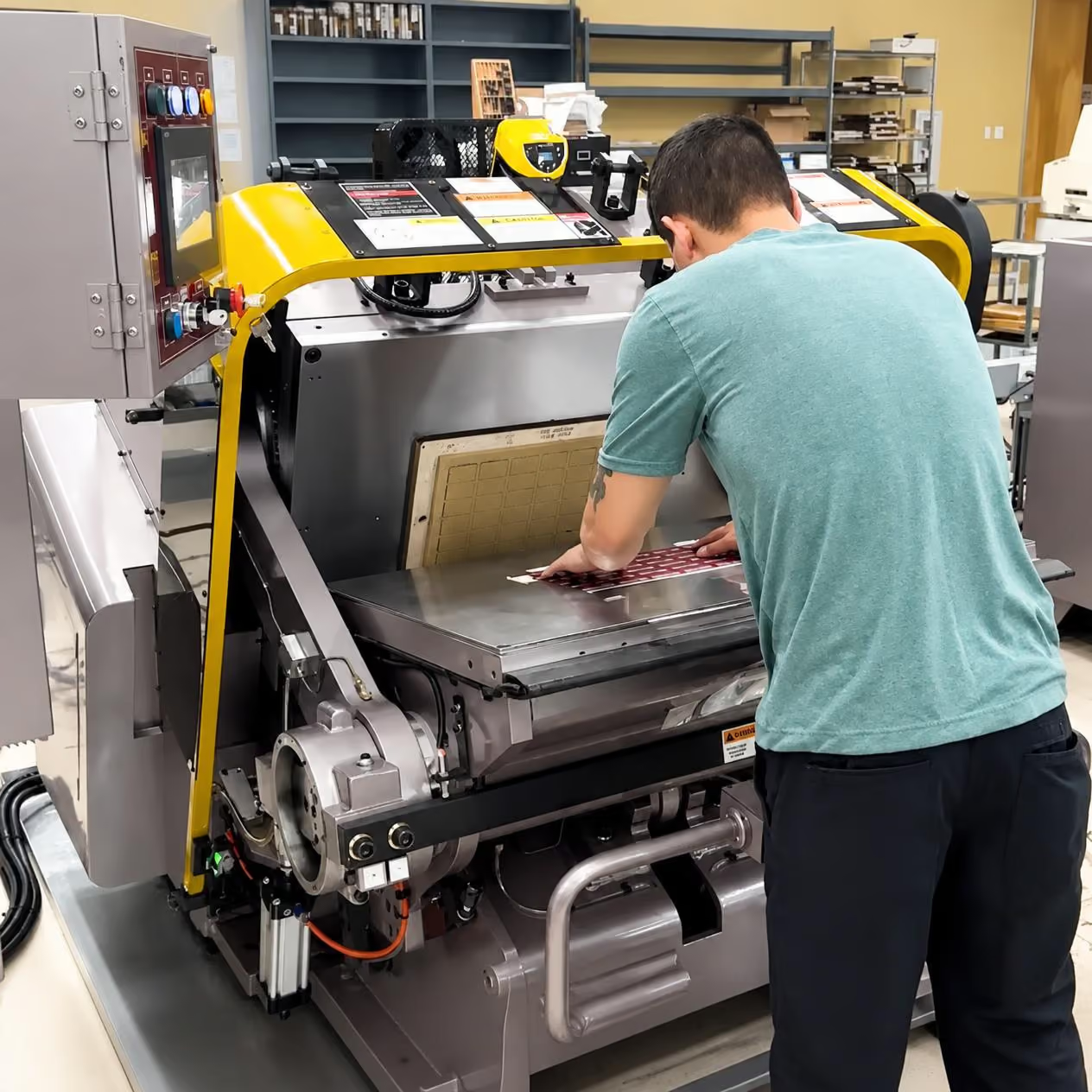
Compact footprint. High job turnover. Precision you can repeat.
The same finite analysis engineering that eliminates platen deflection on larger Crest models is built into every small press. The frame and moving platen are surface ground perfectly flat — which means consistent cutting precision across the sheet and fast changeovers between jobs, whether you're running 50 setups a day or 5.
For manufacturers producing graphic overlays, membrane switches, product identification components, and specialty die cut parts, a small Crest handles the variety without adding setup time.
Materials & Applications
Small Crest presses are used across precision die cutting applications where fast changeovers and consistent accuracy are critical. Common applications include graphic overlays, membrane switches, product identification labels, kiss cutting, foil stamping, presentation folders, packaging components, and specialty die cut parts.
- Styrene and rigid plastics
- Polycarbonate
- Polypropylene
- PVC and vinyl
- Paper and paperboard
- Specialty plastics
- Gasket and spacer materials
- Adhesive-backed materials and laminates
Available Sizes & Specifications
Small Crest presses are available in three formats. Press load tonnage ranges from 260 to 380 tons depending on model.
Average manufacturing lead time for small Crest models is 3 – 3½ months. Delivery may vary based on production levels and inventory at time of order.
- Crest 2026 — 20″ × 26″
- Mobile bed size: 22.125″ × 28.34″
The most compact Crest format — ideal for short runs, frequent job changeovers, and facilities where floor space is limited. - Crest 2332 — 23″ × 32″
- Mobile bed size: 25.39″ × 34.64″
A step up in cutting area and tonnage for facilities running a broader mix of materials and sheet sizes. - Crest 2841 — 28″ × 41″
- Mobile bed size: 30″ × 43″
The largest small format model — well suited for heavier substrates and larger sheet sizes while maintaining the compact footprint and fast setup of the small Crest line.
Built for High Job Turnover
Like all Crest presses, small format models are built from the highest grade raw materials and engineered to run reliably for 20+ years across multi-shift production environments. Every small Crest ships standard with a minimum of one laser safety scanner, meeting and exceeding ANSI, OSHA, CSA, and CE safety standards.
Optional add-ons include heat, foil stamping, embossing, Soft Cut™ urethane pad system, and tonnage monitoring.
Financing Options
A Crest press is a significant capital investment, but the payment structure shouldn't slow down the decision. DCA works with manufacturers to identify financing options that fit their specific situation.
FAQ
Yes. The Crest frame is surface ground perfectly flat and engineered using finite analysis to stay flat and parallel under cutting load. That eliminates the platen deflection that causes shimming and make-ready time on other presses. Operators can move between jobs quickly and consistently.
Small Crest presses are a cost-effective alternative to automated equipment for short-to-medium runs. They deliver the same no-make-ready performance and cutting precision as larger Crest models in a compact footprint — without the cost or complexity of a fully automated system.
Average manufacturing lead time is 3 to 3½ months. Lead times can vary based on production levels and inventory at time of order. Die Cutting Advisors can provide current estimates when you're evaluating a purchase.