Application Guides
Running Soft Cut on Challenging Substrates: A Field Guide
Last updated:
September 9, 2026
.png)

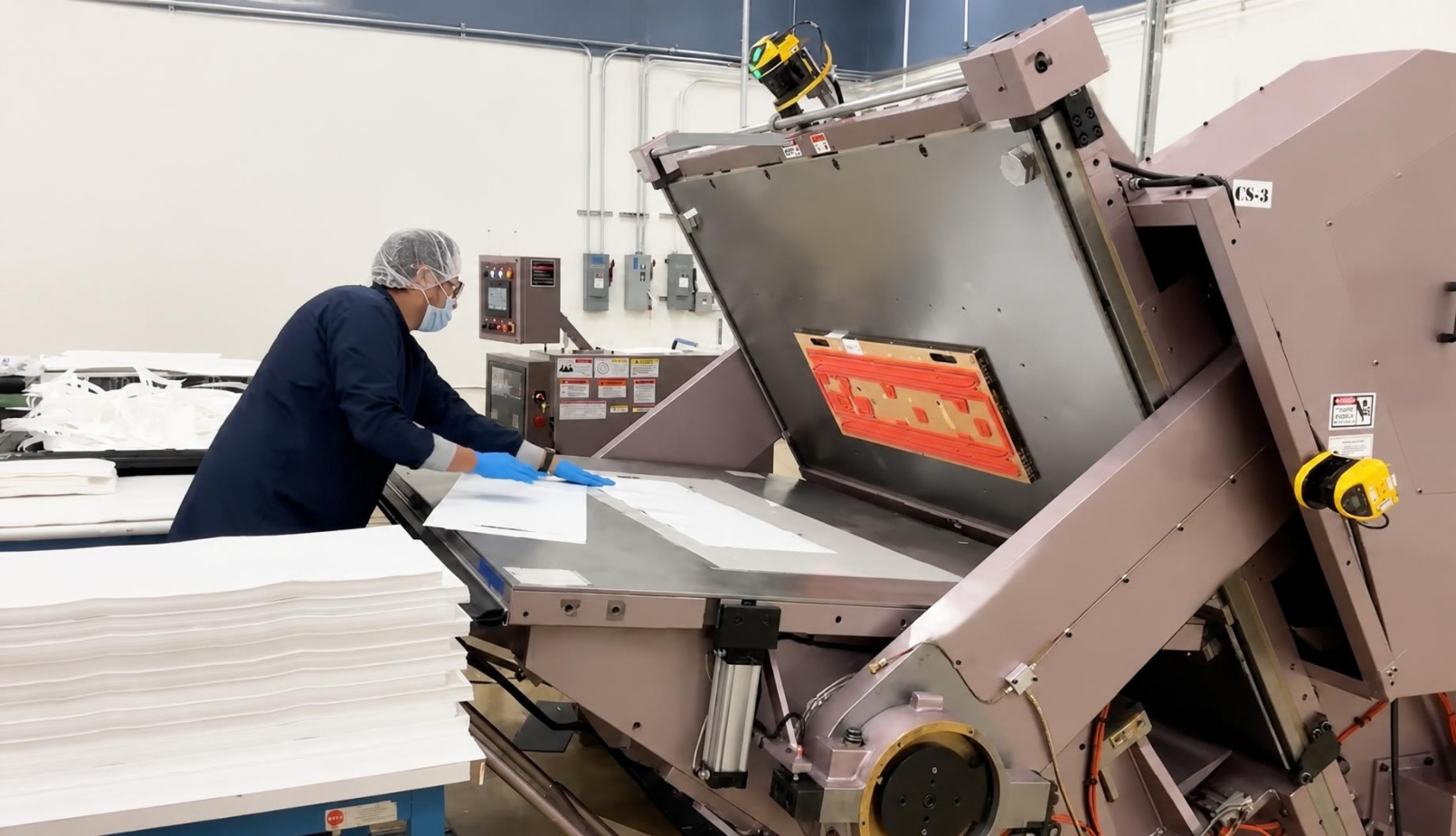
The Soft Cut System was designed to address a specific problem: certain substrates cut poorly on conventional steel rule dies against a hard cutting plate. Foam, film, membrane overlays, gasket materials, and laminated stacks all fall into this category — materials that a clamshell press can handle from a tonnage standpoint but that conventional die cutting tends to damage at the cut edge.
This guide covers the practical setup and substrate-specific considerations for running the Soft Cut System, with particular attention to the materials where the technology delivers the clearest advantage.
The Soft Cut System uses three color-coded urethane pads — Green, Blue, and Orange — each with a different durometer (hardness) profile. The pad selection determines how the cutting force is distributed at the substrate surface and how aggressively the knife penetrates relative to the backing layer.
As a general rule: softer pads (Green) are appropriate for lighter, more delicate substrates where over-penetration and edge damage are the primary concerns. Firmer pads (Orange) are for heavier substrates where complete cut-through requires more force concentration. The Blue pad occupies the middle range and is often the starting point for new applications.
Foam die cutting is one of the applications where Soft Cut most clearly outperforms conventional steel rule. Hard cutting surfaces tend to compress foam rather than cutting cleanly through it, producing ragged edges and varying cut depth across the die area. The urethane pad absorbs the compression and allows the knife to penetrate more cleanly, with more consistent edge quality.
For open-cell foam, start with the Green pad and evaluate cut quality at the standard knife height before adjusting. Closed-cell foam is denser and may require the Blue pad to achieve full penetration. In both cases, knife sharpness is a more significant variable than on conventional board cutting — dull rule on foam substrates shows quality problems faster.
Pressure-sensitive film, membrane switch overlays, and laminated label stocks present a different challenge: the cut must penetrate the top layer cleanly without delaminating the adhesive layer or distorting the substrate at the cut edge. Hard cutting surfaces can cause the film to shift under pressure, producing a cut that's geometrically accurate on the die but dimensionally inconsistent on the finished part.
Soft Cut pads provide a slightly compliant cutting surface that holds the substrate more consistently during the cut cycle. For thin films, the Green pad is typically the starting point. For laminated stacks with multiple layers of different materials, test cuts at varied tonnage settings before committing to a production run.
Graphic overlays and membrane switch components are among the most demanding Soft Cut applications because they combine tight dimensional tolerances, sensitive surface materials, and multi-layer construction. The cut must be clean and precise; surface marring from the die or the cutting surface is a quality failure.
For these applications, ensure that the die face is clean and free of adhesive residue before each run, and inspect pad surface condition regularly — contamination on the pad transfers to the substrate. These are applications where the cleanliness of the setup environment matters as much as the press settings.
Before running a new substrate on the Soft Cut System: confirm knife style and height are appropriate for the material; select starting pad based on substrate type and caliper; run test cuts and evaluate edge quality at both faces of the substrate; adjust tonnage or pad selection if cut quality is incomplete or shows edge damage; document the final settings for repeatable setup on repeat jobs.
If you're working with a substrate type not covered here, DCA can connect you with Soft Cut technical support to work through the setup before you run production.
.png)