Equipment & Technology
What Is a Widemouth Clamshell and Who Needs One?
Last updated:
September 9, 2026
.png)

The Widemouth clamshell is one of the more technically significant developments in clamshell platen press design in recent years — and also one of the more misunderstood. For most packaging operations running standard folding carton or rigid box formats, it's not a relevant consideration. But for a specific set of applications, it solves a problem that previously required a fundamentally different machine. This guide explains what Widemouth is, what it enables, and how to determine whether your operation needs it.
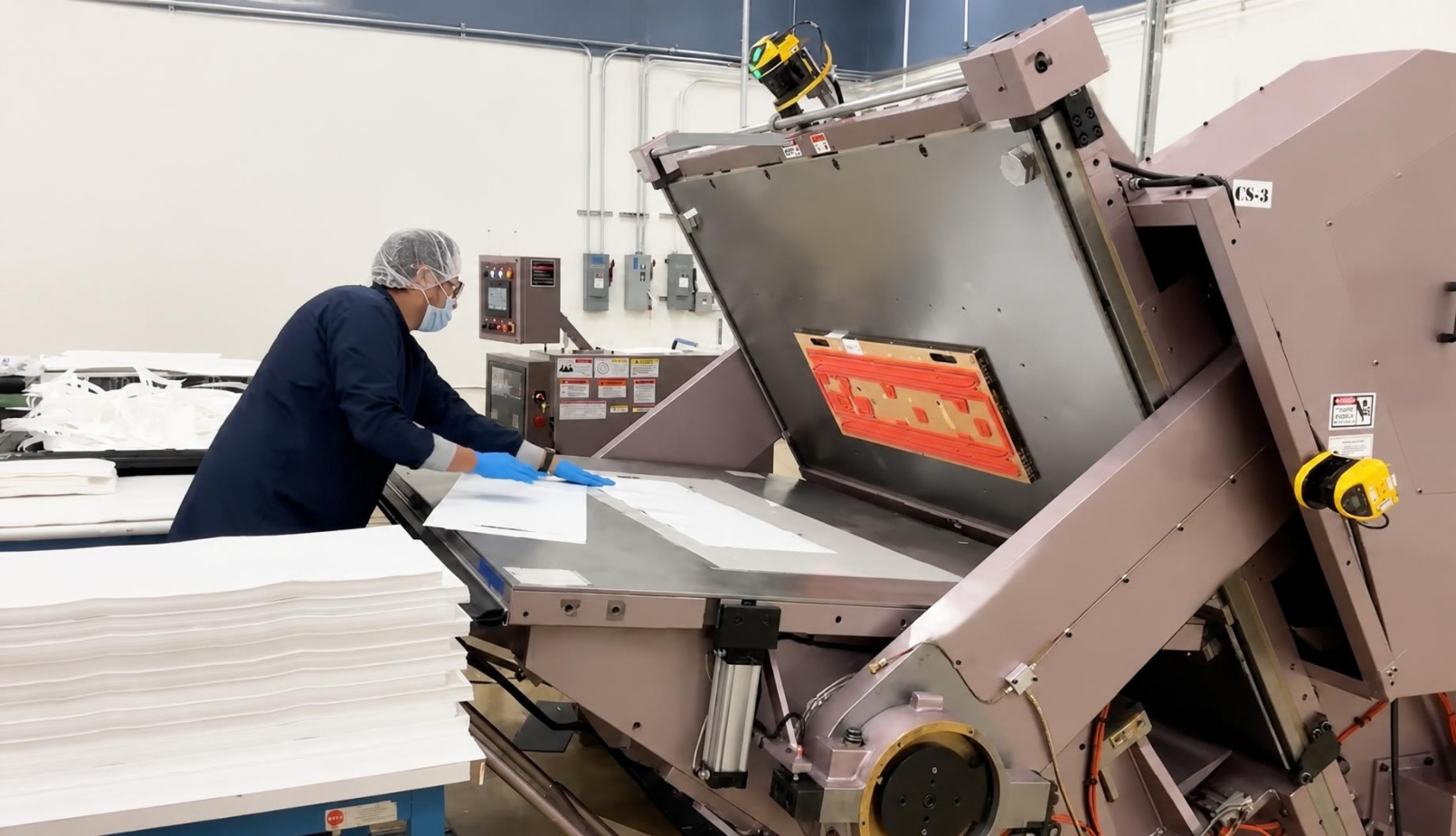
A standard clamshell platen press has a fixed throat depth — the distance from the front of the press opening to the back of the cutting platen. This determines the maximum sheet depth that can be fed and cut. The Widemouth configuration extends that throat, increasing the maximum usable cutting area in the depth dimension and allowing the press to handle larger sheet formats than a standard clamshell throat permits.
On the Crest line, the patented Widemouth configuration is currently available exclusively on the Large format press. The engineering required to extend the throat while maintaining cutting force distribution and platen parallelism is non-trivial, which is why Widemouth isn't a simple field modification — it's a factory configuration.
The most significant practical impact of the Widemouth configuration is the ability to cut material formats and job types that would otherwise require a flatbed table cutter. Large-format corrugated display components, oversized rigid box panels, and certain wide-web converting applications fall into this category.
For operations that run primarily standard packaging formats, Widemouth adds no production value — you're paying for a capability you'll never use. For operations that currently route large-format cutting jobs to a flatbed table, or that turn away certain work because their clamshell can't handle the sheet size, Widemouth changes the calculus meaningfully.
The traditional argument for a flatbed table in large-format work has been format flexibility: a flatbed can handle almost any sheet size up to its maximum. The counterargument for clamshell, even in large formats, is speed and job turnover. A clamshell press running at production speed on a die that fits its format will significantly outrun a flatbed table on comparable work — typically two to five times faster when setup is accounted for.
The Widemouth Crest is making this comparison relevant for a broader range of work than was previously possible. The first Crest 2.5M Widemouth press has been sold into Europe, where large-format converting requirements frequently exceed what a standard clamshell throat accommodates.
You should be evaluating Widemouth if: your operation regularly routes large-format cutting jobs to a flatbed table and that table is a throughput bottleneck; you are turning away corrugated display or large rigid box work because your current clamshell can't handle the format; or you're building a press specification for a new operation and want to maximize format flexibility without purchasing two separate machines.
You don't need Widemouth if your job mix is predominantly standard packaging formats, folding carton, or retail box work within the reach of a standard clamshell throat. In that scenario, the Large Crest in standard configuration — or the Small or Medium — is likely the more appropriate investment.
DCA represents the Crest line across all configurations and can help you assess which format makes sense for your specific work. If Widemouth is on your radar, it's a conversation worth having before you spec the press.
.png)